
HLT62615: ADVANCE DIPLOMA IN AYURVEDA
Take Your Ayurveda Journey to the Next Level
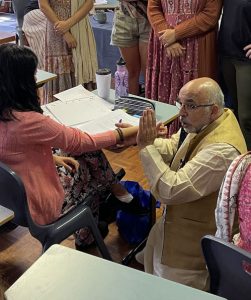
Are you ready to step beyond the scope of practice for Ayurvedic Lifestyle Consultants and become a fully qualified Ayurvedic Practitioner?
The HLT62615 Advanced Diploma of Ayurveda is Australia’s highest level, and government-recognised, qualification in Ayurveda. Designed for graduates of the Diploma of Ayurveda (HLT52615), this program gives you the advanced skills, confidence, and professional recognition to practice at the highest level.
It meets with growing public expectations to access higher trained Ayurveda Practitioners in the community to deal with more complex health issues.
What You’ll Gain
As an Advanced Diploma student, you’ll learn to:
- Diagnose and manage complex health conditions using the traditional 8- and 10-fold principles of Ayurvedic assessment.
- Master advanced assessment techniques – pulse diagnosis, tongue diagnosis, iridology, and advanced Ayurvedic case study work.
- Create and dispense personalised Ayurvedic herbal formulations.
- Provide and evaluate specialised Ayurvedic remedial therapies for a range of clinical conditions and to support deeper healing.
Demonstrate leadership in clinical practice and promote Ayurvedic principles within the wider community.
This training is more than a qualification – it’s a transformative journey that will expand your knowledge, deepen your practice, and prepare you for a fulfilling career helping others.
Why Choose This Course?
✔ Australia’s most advanced government-recognised Ayurveda qualification
✔ Progressive training pathway from Diploma to Practitioner level
✔ Designed and delivered by AIAS – Australia’s leader in Ayurvedic education
✔ Blended delivery to support your lifestyle and commitments
✔ Pathway to stream into further study in degree-level health sciences
Career Pathways
Graduates of the Advanced Diploma can:
- Work as independent Ayurvedic Practitioners in private practice.
- Join integrated healthcare teams, collaborating with allopathic and complementary medicine practitioners.
- Build a meaningful career that combines ancient wisdom with modern healthcare needs.
Graduates hold a higher level of skills and knowledge than Ayurvedic Lifestyle Consultants, positioning them as leaders in the field.
Course Details
A Progressive Learning Pathway:
The Advanced Diploma builds on the Diploma qualification. AIAS has carefully structured the training pathway to ensure students develop their skills step by step, producing confident and capable Ayurvedic Practitioners.
- Duration: 18 months (blended) delivery content
- Entry Requirement: Completion of Diploma of Ayurveda (HLT52615)
- Age Requirement: 17+ (domestic students)
The course is open to all Australian graduates (from any Ayurveda School) of Diploma Ayurveda HLT51625.
Financial Options:
There is no VET Student Loan (fee help) available for Ayurveda Health Courses in Australia Ayurveda courses are self-funded in Australia. Flexible instalment plans are available, making it easier to spread the cost of your studies.
Financial Options:
There is no VET Student Loan (fee help) available for Ayurveda Health Courses in Australia Ayurveda courses are self-funded in Australia. Flexible instalment plans are available, making it easier to spread the cost of your studies.
Ready to Begin?
If you’ve already completed your Diploma of Ayurveda and are ready to step into the role of Practitioner, this is your next step. Review the Ayurveda Diploma course content first, then connect with our Admissions Team (email: [email protected] or telephone 1300 557 487) to discuss enrolment. You will need to send us your qualification parchment from your Ayurvedic Lifestyle Consultant Course.
Take your passion for Ayurveda further – hold the ‘torch’ of Ayurveda and make a real difference in the health and wellbeing of your community.
Courses Structure:
This unit describes the skills and knowledge required to work within the health care system and engage effectively with other health professionals, including writing referral reports
This unit of competency describes the skills and knowledge required to analyse client health information and then plan appropriate health services within the scope of own role. It requires an in-depth knowledge of anatomy and physiology.
This unit delivers the skills and knowledge required to make a detailed investigation of a client’s symptoms that informs the client’s diagnosis within an Ayurvedic framework. This includes – Protocols for performing Ayurvedic health assessments, such as:
- Three-fold examination techniques, Eight-fold examination techniques, Ten-fold examination techniques, and their importance.
- The Importance of pulse diagnosis in clinical practice, including, Locate and identifying the seven levels of the pulse; Identifying Prakriti and Vikriti through pulse examination; Recognise the various channels and related organs through Pulse; Locate and identifying mental Prakriti and present state of mind of the client
- The Importance of Ayurvedic Iridology in clinical practice, including – Identification of Vata, Pitta, and Kapha scar tissue; Recognise imbalances in various channels and related organs through iris diagnosis
- The Importance of Ayurvedic tongue diagnosis in clinical practice, including identifying the location of each channel and organ on the tongue; Recognise imbalances in various channels and related organs through tongue diagnosis.
This unit delivers the skills and knowledge required to make a client diagnosis and structure a treatment plan according to Ayurvedic principles, through an additional 200 hours of supervised Ayurvedic face-to-face training and assessment. This includes knowledge of
- The Ayurvedic disease process: Sanchaya (accumulation), Prakopa (aggravation), Prasara (overflow), Sthana Samshraya (localisation), Vyakti (re-location), Bheda (differential diagnosis) – with special reference to understanding determining and managing the various stages.
- Nidana (Etiology), Rupa (symptoms), Samprapti (pathogenesis), and therapeutic guidelines (Upashya) of diseases state in all channels including:
– Pranavaha – including respiratory but not limited to asthma, cough, hay fever and sinusitis.
– Annavaha – including digestive but not limited to anorexia, hyperacidity, indigestion, dyspepsia and vomiting.
– Ambuvaha – including fluids but not limited to thirst, oedema, and ascites.
– Rasavaha – including lymphatic but not limited to fever, fatigue, chronic fatigue syndrome.
– Raktavaha – including circulatory but not limited to hypertension, gout, anemia, and piles.
– Mamsavaha including muscular but not limited to myomas, muscle atrophy, emaciation.
– Medovaha – including adipose but not limited to obesity and lipomas.
– Asthivaha – including skeletal but not limited to scoliosis, rheumatoid arthritis, osteoarthritis, and cervical spondylitis.
– Majjavaha – including nervous but not limited to attention deficit disorder (ADD)/ attention deficit hyperactivity disorder (ADHD), stress, anxiety, and depression.
– Sukravaha & Arthavavaha & Stanyavaha – reproductive, including but not limited to impotency, menstruation, premenstrual syndrome (PMS), leucorrhoea, lactation but not limited to mastitis, excessive and insufficient lactation.
– Mutravaha – including urinary but not limited to polyuria, diabetes, and dysuria.
Purushivaha – including excretory/stool but not limited to constipation, irritable bowel, dysentery and diarrhea.
– Swedovaha – including integumentary but not limited to psoriasis, eczema, and acne.
– Manovaha – including mental but not limited to poor concentration, negative thinking, and memory loss.
This unit delivers the extensive skills and knowledge required to provide – and personally experience – therapeutic Ayurvedic remedial therapies, such as Ayurvedic specialised massage and herbalised steam therapy, ‘Kizzi Bolus’ (therapeutic herbal bolus treatments), ‘Udwarthanam treatment’, ‘Nasyam’, ‘Netra Basti’, and ‘Karna Purna’. This includes:
- Benefits of treatment
- contra-indications to treatment
- preparation of the herbal Bolus
- structuring a treatment protocol according to constitution and imbalances
- pathological indicators of successful treatment
- Possible reactions to treatment.
This unit delivers the skills and knowledge required to determine a nutritional treatment strategy based on the principles of Ayurvedic nutrition and diet. This includes an understanding of:
- Principles of Ahara, Vihara, and Aushadhi
- Variations necessary with the changing seasons;
- Agnis and their functions
- Types and features of culinary herbs and spices in Ayurveda
- Ayurvedic cooking and food preparation techniques for major food classifications
- Create meal plans for various ailments
- Understand sansaya karma diets, and learn how to prepare the
This unit delivers the skills and knowledge required to determine an ayurvedic medicine treatment strategy based on an existing diagnosis. This includes:
- Over 120 herbs used in Ayurveda, their contraindications, identification and distinguishing features, interrelationships, and incompatibilities
- Principles of formulation (including dosage and duration of treatment) for:
~ Avaleha – a minimum of 5
~ Ghritam – a minimum of 5
~ Kashayam – a minimum of 5
~ Churna – a minimum of 10
~ Guggulu – a minimum of 7
~ Vati – a minimum of 5
~ Asava and Arishta – a minimum of 10
~ Bhasmas – a minimum of 5.
This unit delivers the skills and knowledge required to prepare ayurvedic medicines and dispense those medicines according to a pre-prepared order. This includes:
- sources of Ayurvedic medicines and their raw, semi-processed, processed, and manufactured ingredients and methods to determine quality
- Types of Ayurvedic medicines, what they are, and how they are prepared – techniques to prepare medicines from source materials as per Ayurvedic guidelines, including the practical manufacture of ‘Churna’, x ‘Bati’ and Avaleha’
- Equipment and instrumentation components, purpose and operation – recording requirements and procedures environmental conditions required to maintain the integrity of medicines before, during and after preparation.
This unit delivers the skills and knowledge required to monitor and evaluate ayurvedic treatments, both from an individual client and a whole practice perspective. This includes:
- Types of criteria by which Ayurvedic treatments are evaluated, including regular client follow-ups and feedback.
- Typical complications associated with different treatments and therapies and how to respond in an ongoing treatment plan; sources of research and evidence that support Ayurvedic practice principles underpinning continuation or variation of treatment and the Ayurvedic rationale that underpins these.